The Great Flood (2025) Review: Netflix’s Korean Disaster Film Is Bigger, Darker, and More Thought-Provoking Than Expected

South Korean cinema has earned a global reputation for transforming genre films into emotionally resonant, socially reflective experiences. The Great Flood (2025), Netflix’s latest Korean disaster release, follows that tradition — but not in the way viewers might expect. What begins as a tense survival thriller gradually becomes a more unsettling meditation on memory, sacrifice, and the ethics of survival itself.
The Great Flood (2025) Movie: A Korean Disaster Film That Dares to Think Bigger
Directed by Kim Byung-woo, the film has already sparked polarized reactions online, praised for its ambition and questioned for its narrative risks. This review breaks down what The Great Flood is about, why it matters now, and whether it’s worth watching.
This review breaks down the film’s plot, themes, performances, production, critical reception, and where you can watch it.
Why The Great Flood Matters Right Now
Although The Great Flood unfolds in a speculative near future, its anxieties feel unmistakably contemporary. Climate instability, environmental displacement, and humanity’s increasing reliance on technological solutions are no longer abstract concerns, they are part of everyday global conversations. The film reflects this unease by framing global catastrophe through a deeply personal crisis rather than sweeping political spectacle.
South Korean cinema has repeatedly demonstrated its ability to translate collective fears into human-scale stories. The Great Flood continues this approach, using disaster not as an endpoint, but as a catalyst to examine how societies define survival, responsibility, and progress when familiar structures begin to collapse.
What Is Netflix’s The Great Flood About? (Spoiler-Free)
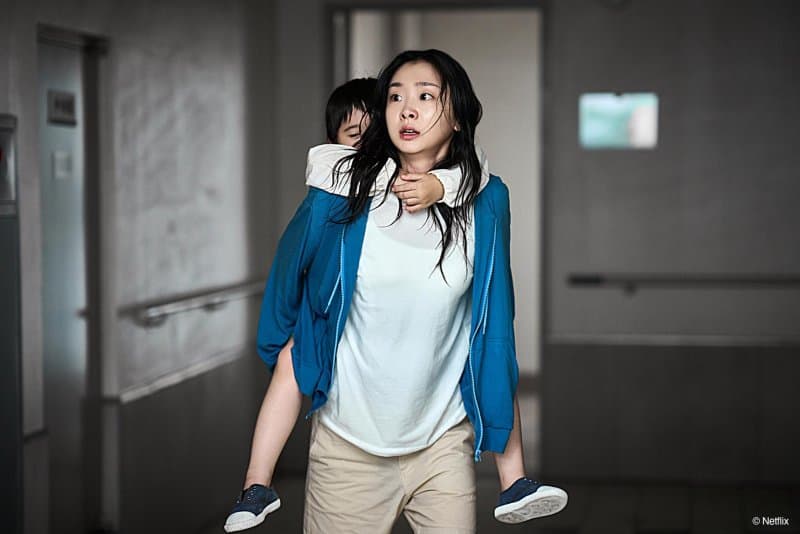
Set during a period of worldwide environmental collapse, The Great Flood follows Gu An-na, a scientist and single mother, as relentless flooding submerges cities and forces survivors into vertical refuges. Trapped inside a rapidly flooding building with her young son, An-na must rely on her intelligence, instincts, and resilience to survive the immediate disaster.
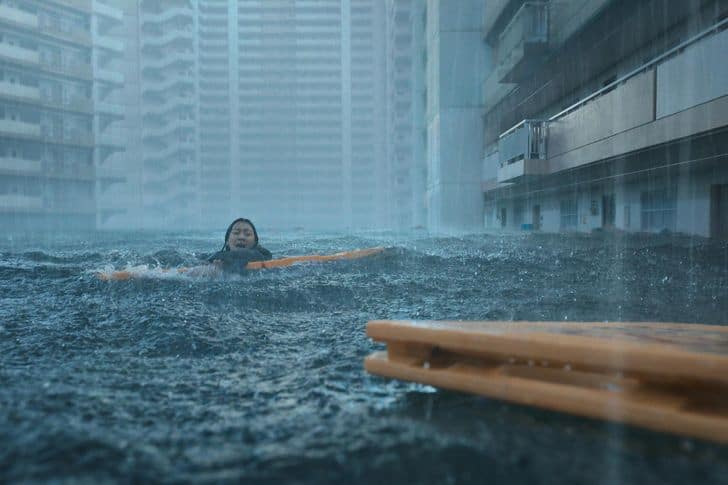
As rescue efforts falter and resources disappear, the film initially plays like a classic survival thriller, narrow escapes, rising water levels, and mounting tension. Midway through, however, the narrative begins to shift. Unsettling science-fiction elements emerge, tied to An-na’s past research and a mysterious project that may hold implications far beyond individual survival.
Rather than focusing solely on spectacle, the film uses catastrophe as a backdrop to explore deeper questions about motherhood, ethical responsibility, and the limits of scientific intervention. While it avoids easy answers, The Great Flood rewards viewers willing to engage with its layered storytelling.
How The Great Flood Balances Disaster and Science Fiction
The film’s first half aligns closely with traditional disaster storytelling, emphasizing immediacy, confinement, and physical danger. Rising water levels and failing infrastructure create sustained urgency, grounding the viewer in survival mode.
As the story progresses, The Great Flood deliberately shifts toward cerebral science fiction. Questions of memory, reality, and control move to the forefront. Rather than abandoning its disaster roots, the film uses them to support deeper philosophical inquiry. This tonal transition is intentional and central to the film’s identity, distinguishing it from more conventional genre entries.
Cast and Performances
Kim Da-mi as Gu An-na
Park Hae-soo as Son Hee-jo
Kwon Eun-seong as Ja-in
Kim Da-mi delivers the emotional core of the film. Her portrayal of An-na balances scientific rationality with raw maternal fear, grounding the story even as it ventures into high-concept territory. Much of the film’s tension depends on her performance, and she carries it with conviction.
Park Hae-soo brings restrained intensity to a role that grows increasingly significant as the narrative unfolds. The cast as a whole ensures that The Great Flood never feels emotionally hollow, even when its ideas become abstract.
Direction, Production, and Visual Style
Under Kim Byung-woo’s direction, The Great Flood showcases confident technical craftsmanship. The flooded interiors are claustrophobic and convincing, with water functioning not merely as a visual effect but as a constant narrative threat.
The production design emphasizes confinement and decay, while sound design, creaking structures, rushing water, distant alarms, heightens unease. As the story transitions toward science fiction, the visuals become colder and more clinical, subtly reflecting the film’s thematic shift from survival to existential questioning.
Themes and Deeper Meaning
At its core, The Great Flood is not simply about a natural disaster, it is about choice.
Key themes include:
- Motherhood and sacrifice – An-na’s decisions are driven by her need to protect her child, even when the consequences extend beyond her family.
- Science and ethics – The film questions whether technological solutions can truly save humanity without moral compromise.
- Reality versus control – As the narrative unfolds, viewers are asked to consider whether survival holds meaning if it comes at the cost of autonomy and truth.
These themes elevate the film beyond standard disaster storytelling, even as they contribute to its divisive reception.
What May Divide Viewers (Non-Spoiler)
The Great Flood prioritizes thematic depth over constant momentum. The pacing slows considerably in the latter half, allowing its ideas to unfold, but this approach may challenge viewers expecting uninterrupted action.
The film also resists definitive emotional closure. Instead of clear resolutions, it invites interpretation and reflection. These creative decisions explain why reactions have been polarized, but they also distinguish the film from more formulaic genre offerings.

Content Advisory
The film contains intense disaster imagery, sustained psychological tension, and scenes involving a child in life-threatening situations. Viewer discretion is advised.
Why The Great Flood Has Divided Critics and Viewers
Since its release, The Great Flood has received mixed to polarized responses. Critics widely praised its opening half for sustained tension, immersive disaster sequences, and strong performances. The film’s ambition and genre-blending approach were frequently acknowledged.
However, some reviewers felt the later science-fiction developments were overly complex or emotionally distancing. Audience reactions mirrored this divide: fans of cerebral science fiction admired its ideas, while viewers expecting a straightforward disaster thriller found the shift jarring.
Ultimately, The Great Flood is a film that invites discussion rather than consensus. Since its global Netflix release in December 2025, The Great Flood has continued to trend in online discussions, particularly among fans of Korean science fiction and slow-burn thrillers.
Where to Watch The Great Flood
The Great Flood is available exclusively on Netflix, with a global release beginning in December 2025.
The film includes:
- Multiple subtitle options
- Dubbed versions in select languages
- High-definition streaming support
A Netflix subscription is required to watch.
FAQs About The Great Flood
Is The Great Flood based on a true story?
No. It is a work of speculative fiction inspired by real-world environmental concerns.
Is the film more disaster-focused or science fiction–driven?
It begins as a disaster survival story and gradually transitions into science fiction.
Is The Great Flood suitable for children?
Due to its themes and intensity, it is better suited for mature viewers.
Does the film include a post-credit scene?
No post-credit scene has been officially indicated.
Is The Great Flood Worth Watching on Netflix?
The Great Flood is not designed to please everyone — and that may be its most defining trait. Rather than delivering a familiar disaster spectacle, the film challenges viewers to sit with discomfort, ambiguity, and ethical uncertainty.
Viewers who appreciate thoughtful science fiction, slow-burn tension, and genre-defying narratives will find much to admire. Those seeking fast-paced spectacle and clear resolutions may find its narrative direction demanding.
Either way, The Great Flood stands as another example of South Korean cinema’s willingness to take creative risks, even when the results are divisive. Have you seen this movie? What is your thought?